
















Introduction
Most organizations still treat identity verification as a one-time event. But as synthetic identities evolve, that model is collapsing. Fraud today doesn’t stop at onboarding, it adapts, learns, and exploits trust over time. This article breaks down the four stages of identity defense maturity, why most companies are stuck at Stage 1, and how explainable AI can help you progress toward continuous, orchestrated protection.
Key Takeaways
- Identity defense maturity determines fraud resilience, Stage 1 organizations verify once, while Stage 4 verifies continuously and adaptively.
- Synthetic identities blend real and fake data to bypass static verification, causing exponential loss growth.
- Continuous authentication (Stage 3) and orchestrated intelligence (Stage 4) use behavioral biometrics, device intelligence, and explainable AI for real-time trust decisions.
- Explainability is the foundation of maturity: analysts, auditors, and regulators need transparent reasoning, not black-box outputs.
- Compliance frameworks like the EU AI Act, DORA, and FinCEN guidance are accelerating adoption of continuous, auditable verification models.
Your competitor just stopped a $340,000 synthetic-identity bust-out. You didn’t.
Same industry. Similar customers. Near-identical attack. The difference wasn’t luck, it was maturity.
Most organizations are still perfecting Stage 1 (check documents at the door) while leaders have advanced to Stages 3 to 4, verifying identity continuously across channels and time. The loss-prevention gap between these groups isn’t incremental, it’s exponential.
Synthetic identity cases in North America have more than tripled since 2024, with losses projected to hit $23B by 2030. The hardest-hit organizations aren’t doing verification “wrong”, they’re doing an outdated version of it.
This isn’t about “more security.” It’s about evolving architecture to match how fraud actually works now.
Stage 1: Static Verification (Where Most Organizations Live)
What it looks like: One-and-done onboarding. You check documents, run a face match, confirm data points. If it all passes, long-term trust is granted.
Why it made sense: For years, stolen identities had real victims who eventually complained; forged docs carried visible defects; scalable synthetic biometrics didn’t exist.
Why it fails now: Synthetic IDs have no victims. They blend real data (SSN, address) with fabricated attributes (AI photo, fake name, cloned voice). They behave “normally,” build trust, then execute a bust-out.
Single-moment checks can’t catch fraud designed to evolve after the checkpoint, and there’s no mechanism to surface cross-channel anomalies later.
The trap: Trying to “perfect the front door” (more forensic checks, more sources) helps at the margins but doesn’t fix the core problem: you’re still trusting a moment in time.
Stage 2: Layered Checks (Better, But Not Enough)
What it looks like: Multiple controls at onboarding, document forensics, biometric match, liveness, device fingerprinting.
Why it’s better: Adversaries must beat several controls at once; obvious fakes drop; FP rates typically improve.
Why it’s incomplete: All layers still fire at one moment. Sophisticated synthetics are engineered to pass multi-factor onboarding, then exploit trust over time. Siloed tools (docs vs. device vs. face) also miss cross-signal patterns that expose rings.
Result: Fraud happens after the checkpoint, during the “trusted” period.
Stage 3: Continuous Authentication (Where the Gap Widens)
What it looks like: Verification doesn’t stop at onboarding. You verify throughout the lifecycle using behavioral biometrics, device intelligence, and session context, feeding dynamic, real-time risk scores.
Why it changes the game: Fraudsters can fake a moment, they can’t fake patterns.
Behavioral biometrics (typing cadence, cursor dynamics, mobile posture, scroll patterns) are stable for real users and nearly impossible to mimic consistently. Combine with device posture, geolocation, velocity checks, and you get low-friction, background verification. When risk rises, you step up; when trust is earned, you step down.
The advantage: Double-digit fraud reductions and better UX. Legitimate users sail through; adversaries hit adaptive friction.
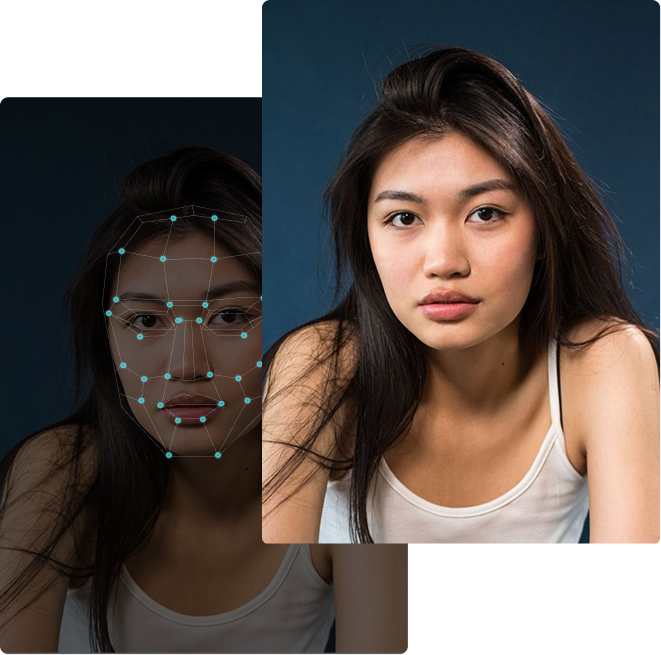
Where DuckDuckGoose helps: Our explainable deepfake detection feeds human-readable reasons (e.g., lip-sync anomaly, voice frequency mismatch) into your risk engine so Stage-3 policies can weight signals and analysts instantly understand why a user was flagged.
Stage 4: Orchestrated Intelligence (Best-in-Class Defense)
What it looks like: Deepfake detection, document forensics, behavioral biometrics, device & network intel all flow into a unified orchestration layer making dynamic decisions on real-time risk.
- Low-risk: Known device + stable behavior + routine action → minimal friction.
- High-risk: New device + behavioral anomalies + high-value request → MFA + out-of-band confirmation + analyst review.
What’s different: Policies learn and adapt. Threat intel updates rules; user pattern shifts (travel, device change) adjust trust models automatically. Add consortium intelligence (identity graphs/networks) to spot patterns no single org can see.
Compliance as advantage: EU AI Act, DORA, NIS2, FinCEN, all expect transparency, monitoring, explainability. Stage-4 orgs already have traceable rationales tied to inputs and model versions. Audits become answerable.
Results we see:
- 70 to 80% reductions in targeted identity-theft patterns
- Millions in prevented losses via orchestrated detection
- Faster analyst decisions with explainable AI
- Lower false positives through intelligent signal weighting
- Year-one ROI from reduced manual work + fewer incidents
How DuckDuckGoose enables Stage 4: Our detector outputs weighted, explainable signals (regions, anomaly type, confidence). Your orchestration can act intelligently: “Docs pass; video shows lip-sync anomaly; voice off-profile → step-up + OOB confirm.” Analysts get context; auditors get traceability; models get better.
The Maturity Migration Path: Stage 1 → Stage 4
You don’t leap overnight. You iterate.
If you’re at Stage 1 (Static)
- Months 1 to 3: Add explainable deepfake detection to onboarding (start with video or voice). Measure catch-rate on missed synthetics.
- Months 4 to 6: Add device intel and basic behavioral signals at verification moments.
- Months 7 to 9: Pilot risk-based orchestration for one workflow (wires, account changes, VIP actions).
If you’re at Stage 2 (Layered)
- Months 1 to 2: Connect silos. Ensure docs, device, and face signals feed a shared risk view.
- Months 3 to 4: Deploy behavioral biometrics in observe-only mode.
- Months 5 to 6: Turn on adaptive auth for medium-risk scenarios.
If you’re at Stage 3 (Continuous)
- Months 1 to 2: Add consortium/network intelligence.
- Months 3 to 4: Build policy-as-code orchestration tied to threat intel.
- Months 5 to 6: Ensure every decision is explainable & auditable.
Non-negotiable across all stages: Explainability. Black-box outputs stall maturity. Analysts need reasons; risk models need interpretable signals; auditors need proof.
The Cost of Staying Behind
The $23B headline matters, but the bigger cost is competitive disadvantage:
- Stage 3 to 4 orgs reduce fraud and lower friction, lifting conversion and retention.
- Stage 1 orgs add more front-door friction yet still lose to sophisticated attacks designed to pass that door.
- The gap compounds: leaders accumulate richer behavioral baselines, device intel, and tuned risk models, learning faster every month.
Moving Up the Curve
The winners share three mindsets:
- Identity is continuous, not binary. Trust is earned and re-earned in context.
- Demand explainability. Scores alone don’t scale; reasons unlock action.
- Use compliance as acceleration. EU AI Act, DORA, NIS2, FinCEN aren’t obstacles, they justify the architecture you need.
Synthetic identity fraud will accelerate as gen-AI gets cheaper and more convincing. The question isn’t whether to mature, it’s how fast you do it and how much loss you absorb while deciding.
How DuckDuckGoose AI Helps You Level Up
We don’t add noise, we add explainable intelligence that makes each stage operationally viable.
- Stage 1 → 2: Add real-time deepfake detection with human-readable reasoning to onboarding. Catch synthetic biometrics your checks miss.
- Stage 2 → 3: Feed explainable, cross-channel signals into continuous auth so the engine can act, confidently.
- Stage 3 → 4: Supply weighted, interpretable detections to your orchestration layer for adaptive, policy-driven decisions.
What sets us apart
- Explainability by design: Every detection = where + what + confidence, not just a score.
- Seamless integration: Drop into existing KYC, AML, fraud, and approval workflows, no re-architecture.
- Compliance-ready: Aligned with EU AI Act, DORA, NIS2, FinCEN from day one.
- Cross-modal coverage: Images, video, audio, documents, consistent, actionable outputs.
We help you mature without adding operational drag, because the only sustainable answer to industrial-scale fraud is industrial-scale intelligence your team can understand and use.
.webp)
About the author