











.png)
Blog

Why Identity Fraud Happens After Onboarding, Not During It


See our deepfake detection flag a fake selfie, document, or voice clone inside a live identity verification flow. Book 30 minutes and watch it run on your own KYC data, in seconds.
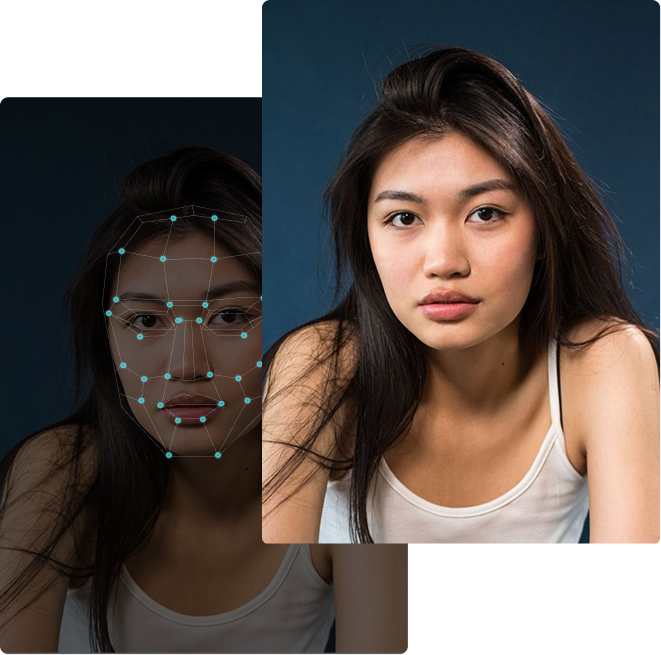



Face swapping is the technique of digitally replacing one person's face with another's in an image or video while preserving the original head pose, lighting, and surrounding scene.
It is the foundational deepfake category, the one that gave the technology its name, and remains the dominant attack vector against video-based identity verification.
For IDV operators, face swaps arrive both as pre-recorded video uploads and as real-time injected streams during selfie verification or video KYC.
Beyond IDV, face swaps drive non-consensual intimate imagery, executive impersonation in earnings calls, and political disinformation at scale.
Open-source toolkits such as DeepFaceLab, FaceFusion, and SimSwap have made high-quality face swaps achievable on consumer hardware in hours rather than weeks.
Real-time variants like DeepFaceLive run at 25-30 fps on a single mid-range GPU, enabling face swaps inside live video calls and KYC sessions.
Diffusion-based face swap models released since 2024 produce results that defeat detectors trained on earlier autoencoder-based outputs.
Face matching engines tuned for tolerance, to reduce FRR, match swapped faces against either source identity unless explicit authenticity checks are added.
Subtle artifacts at the face boundary, in eye reflections, or in temporal coherence are not visible at standard playback and are missed by manual reviewers.
Single-image detection is weaker than video detection because temporal cues (blink rate, head-motion-to-face-warp consistency) are unavailable.
Run deepfake detection specifically tuned for face-swap artifacts in addition to liveness and PAD.
Verify the face image against the live capture using multiple modalities: pixel-level forensics, temporal coherence across frames, and challenge-response liveness.
Treat any high-risk action initiated over video (large transfer, executive directive, account recovery) as requiring out-of-band re-verification.


Deepfakes themselves are not inherently illegal, but their use can be. The legality depends on the context in which a deepfake is created and used. For instance, using deepfakes for defamation, fraud, harassment, or identity theft can result in criminal charges. Laws are evolving globally to address the ethical and legal challenges posed by deepfakes.
Deepfake AI technology is typically used to create realistic digital representations of people. However, at DuckDuckGoose, we focus on detecting these deepfakes to protect individuals and organizations from fraudulent activities. Our DeepDetector service is designed to analyze images and videos to identify whether they have been manipulated using AI.
The crimes associated with deepfakes can vary depending on their use. Potential crimes include identity theft, harassment, defamation, fraud, and non-consensual pornography. Creating or distributing deepfakes that harm individuals' reputations or privacy can lead to legal consequences.
Yes, there are some free tools available online, but their accuracy may vary. At DuckDuckGoose, we offer advanced deepfake detection services through our DeepDetector API, providing reliable and accurate results. While our primary offering is a paid service, we also provide limited free trials so users can assess the technology.
The legality of deepfakes in the EU depends on their use. While deepfakes are not illegal per se, using them in a manner that violates privacy, defames someone, or leads to financial or reputational harm can result in legal action. The EU has stringent data protection laws that may apply to the misuse of deepfakes.
Yes, deepfakes can be detected, although the sophistication of detection tools varies. DuckDuckGoose’s DeepDetector leverages advanced algorithms to accurately identify deepfake content, helping to protect individuals and organizations from fraud and deception.
Yes, if a deepfake of you has caused harm, you may have grounds to sue for defamation, invasion of privacy, or emotional distress, among other claims. The ability to sue and the likelihood of success will depend on the laws in your jurisdiction and the specific circumstances.
Using deepfake apps comes with risks, particularly regarding privacy and consent. Some apps may collect and misuse personal data, while others may allow users to create harmful or illegal content. It is important to use such technology responsibly and to be aware of the legal and ethical implications.
Synthetic faces. Cloned voices. Documents generated in the time it takes to read this sentence. DuckDuckGoose is the detection layer that catches what liveness can't — on every image, video, and audio your platform sees.

.png)
.webp)
%20(1).webp)
.webp)
.webp)
.webp)
.webp)
.webp)